Static Search and Filtering Manual
For current controls, use Use Explorer. The dated screenshots below are retained as historical illustrations; they may show older layout and selection behaviour.
This illustrated manual covers the deterministic search and filtering
interface introduced on codex/static-search-filtering. It uses the real
GOV.UK CKAN descriptor: 58,461 datasets, 268,241 resources and 1,960,101
relationships.
Why the hosted Explorer may still look unchanged: at capture time, the public Pages site served the pre-feature
main. These screenshots were captured from the local Pages build of the feature branch on 2026-07-13. If the hosted controls still differ, confirm that this branch has been reviewed, merged and deployed.
Explorer remains a static browser application. Search does not call an LLM, embedding service, Vespa deployment, remote retrieval service or agent API.
1. Recognise The New Controls
The left panel now separates three tasks, with Search remaining persistent and the other controls grouped into task tabs:
- Search finds lexical matches in the static index.
- Facets and Browse reduce the candidate set using structured metadata or provider-defined hierarchies.
- Results contains sort order and the resulting record list.
The capture below records the preceding flat-panel implementation used for the verified CKAN journey. Search and facet semantics are unchanged, but Sort and the record list have since moved into Results and hierarchy rows into Browse.
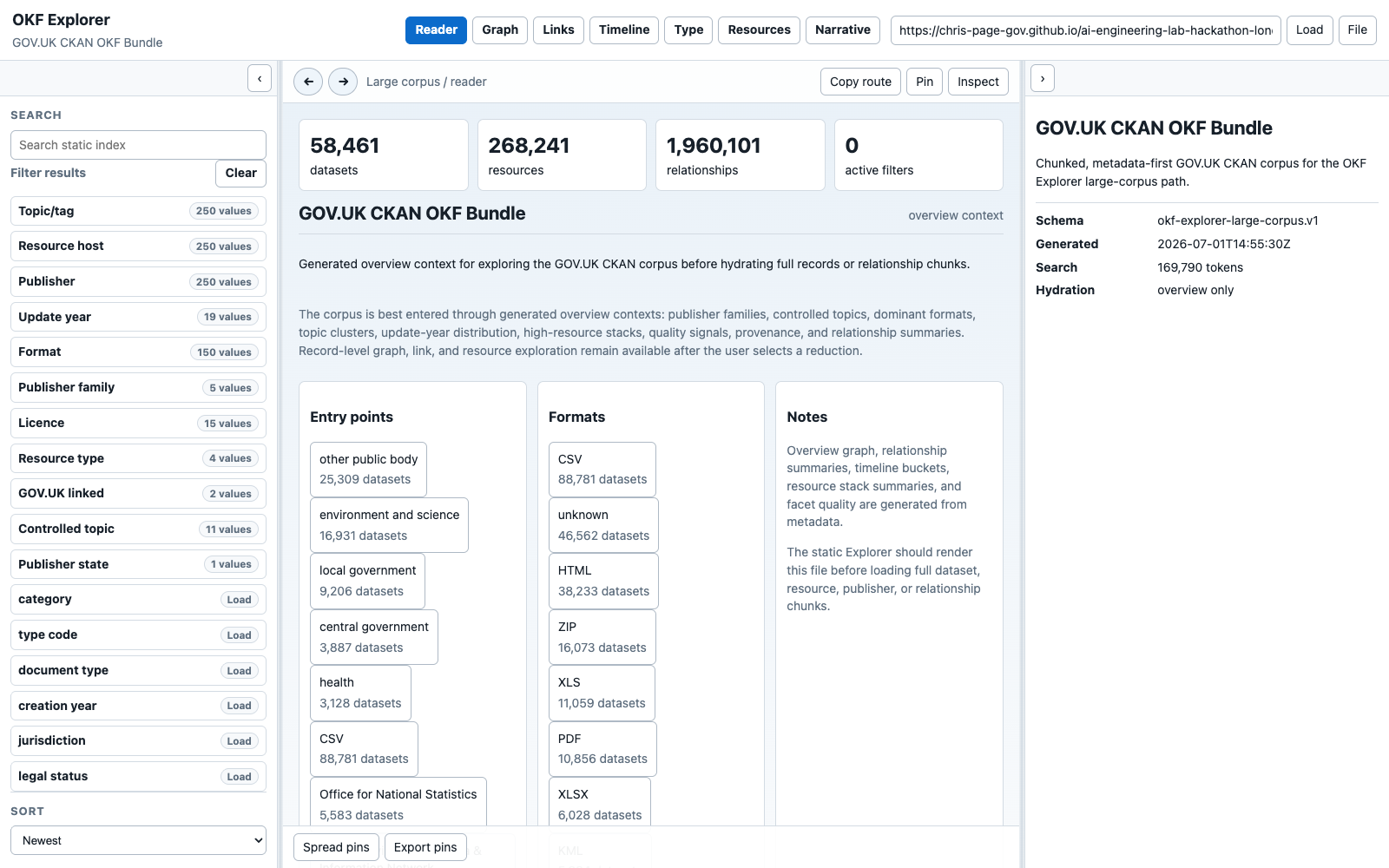
In this unfiltered state:
- the metrics show the complete large-corpus overview;
- facets remain folded until opened, with compact distributions or search previews in their closed state;
- the default sort is Title because there is no text query;
- the application has loaded only overview context, not every record; and
- the selected route remains in the URL hash.
The public CKAN descriptor in the screenshot uses the v1 search manifest. The branch deliberately retains that compatibility path. A regenerated v2 corpus uses the same interface and URLs but can apply indexed filter postings without hydrating the full record index.
2. Search And Read The Result Total
Enter ordinary words or a known identifier in Search. Text queries default to Relevance unless the URL or user explicitly selects another order.
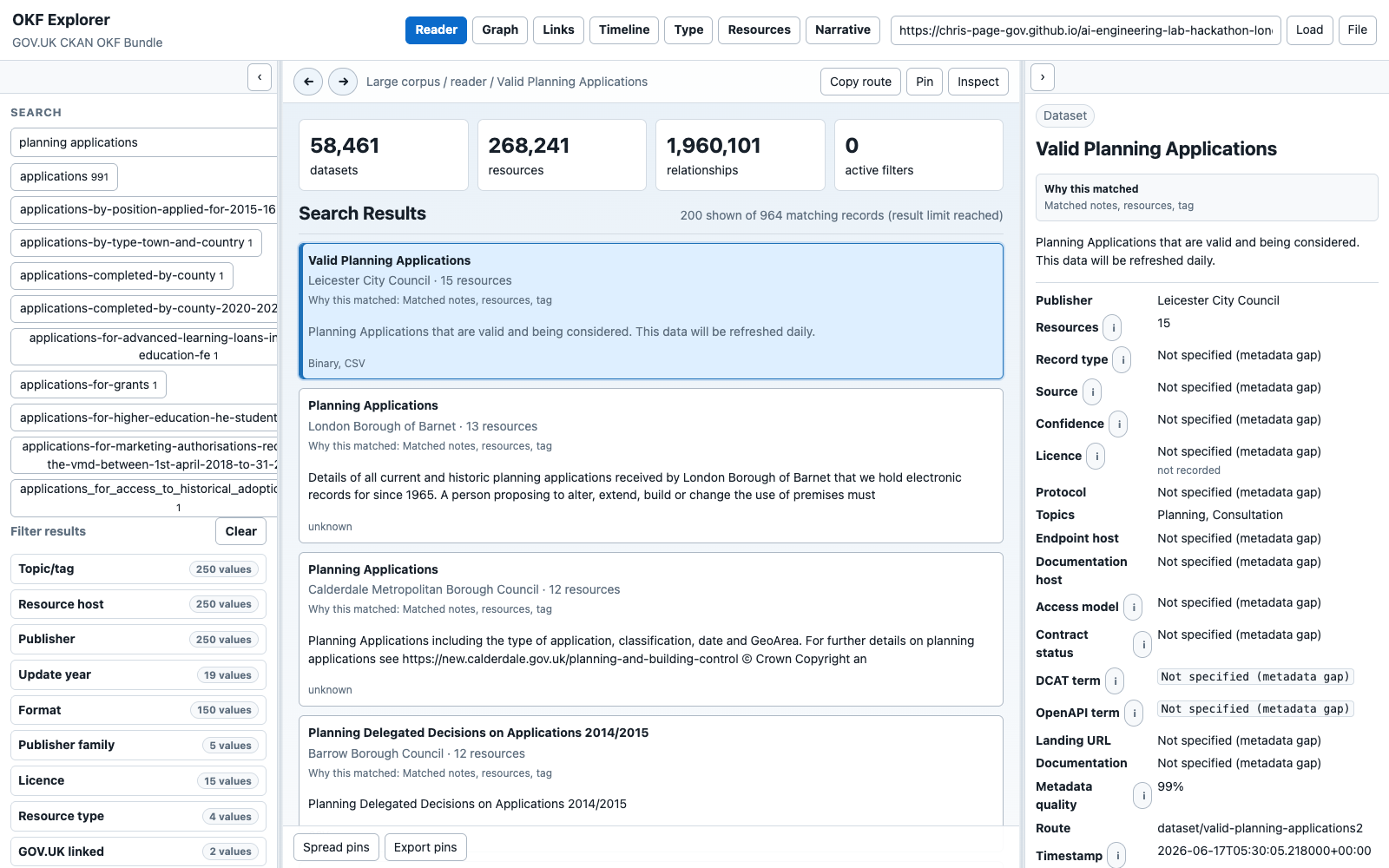
The planning applications example demonstrates several new behaviours:
200 shown of 964 matching records (result limit reached)distinguishes the displayed page from the complete candidate count;- every result says which indexed fields matched instead of displaying an unexplained numeric score;
- the selected record repeats its match explanation in the right panel;
- inferred, confidence and metadata-quality fields remain visible as signals, not assurances; and
- missing metadata is rendered as
Not specified (metadata gap)rather than rawNone,nullor an empty value.
“Why this matched” describes deterministic evidence such as title, notes, resources, tags, provider or identifier fields. It is not a generated answer and does not claim that the record is authoritative, complete or operational.
Search for an organisation or abbreviation
Organisation names should not behave like unrelated everyday words. When an
exact query uniquely identifies a publisher, Explorer shows the interpretation
and uses that publisher's existing static postings as the candidate set. For
example, Home Office is interpreted as the Home Office organisation rather
than separate matches for “home” and “office”. An unambiguous initialism such as
DSIT resolves to Department for Science, Innovation and Technology even when
the letters are not a lexical term in the record text.
The behaviour stays inspectable:
- autocomplete labels a recognised Organisation and its record count instead of exposing a wall of raw token completions;
- the search panel states which organisation was recognised;
- every result's “Why this matched” text repeats the interpretation; and
- ambiguous abbreviations remain ordinary queries until the user chooses a specific entity.
New okf-static-search.v2 bundles can publish authoritative labels and aliases
in data/search/entities.json. Older CKAN v1 bundles derive exact organisation
names and conservative initialisms from the compact publisher facet and reuse
its delta-encoded postings, so this recognition does not require full-corpus
hydration. Explicit aliases supplied by a bundle take precedence over inferred
initialisms.
How a v2 producer can govern multi-word queries
A producer may opt an okf-static-search.v2 manifest into the exact
okf-search-query-policy.v1 contract. The declaration supplies:
- the fixed
nfkd-lowercase-ascii-alphanumeric-component-v1tokeniser; - a sorted, unique and bounded list of producer stopwords; and
- integer minimum-should-match parameters: an application threshold, a fixed minimum and a ratio numerator and denominator.
Explorer normalises each query with NFKD, removes combining marks, lowercases it, splits it into ASCII letter-or-number components, applies the manifest's existing minimum token length, removes the declared stopwords and keeps the first occurrence of each remaining token. If there are fewer tokens than the application threshold, one resolved group is required. At or above the threshold, the required group count is the larger of the fixed minimum and the rounded-up integer ratio, capped at the query-token count. Unresolved tokens remain in that denominator; they do not silently make the query easier.
The worker response includes bounded query_policy counts and ordered
unresolved_tokens, so producer and evaluation tooling can inspect how many
distinct groups were supplied, resolved and required. These internal counts
are not currently rendered as an Explorer interface explanation. Recognised
entities and bounded typo correction still use the same group accounting. An
exact one-component entity alias is a resolved semantic group only when its
governed ordinal postings are available; otherwise Explorer uses ordinary
lexical resolution and reports the actual outcome.
This behaviour is opt-in. A v2 manifest without query_policy and every
existing v1 manifest retain their previous strict-AND/tokeniser behaviour.
Small bundles retain their existing in-memory, lower-case substring search.
The exact producer schema, bounds and formula are recorded in the static
search and filtering design.
3. Add And Remove Filters
Open a facet and select a value to highlight its set. A normal click on an unselected value replaces the selection in that facet; clicking a selected value removes it. Ctrl-click or Cmd-click, or Select multiple values, enables multiple values. Use Keep highlighted to reduce scope. The dated screenshot below illustrates a reduced set, not the effect of a single highlight click.
The semantics are fixed and shareable:
- AND between different facets; and
- OR between multiple values in the same facet.
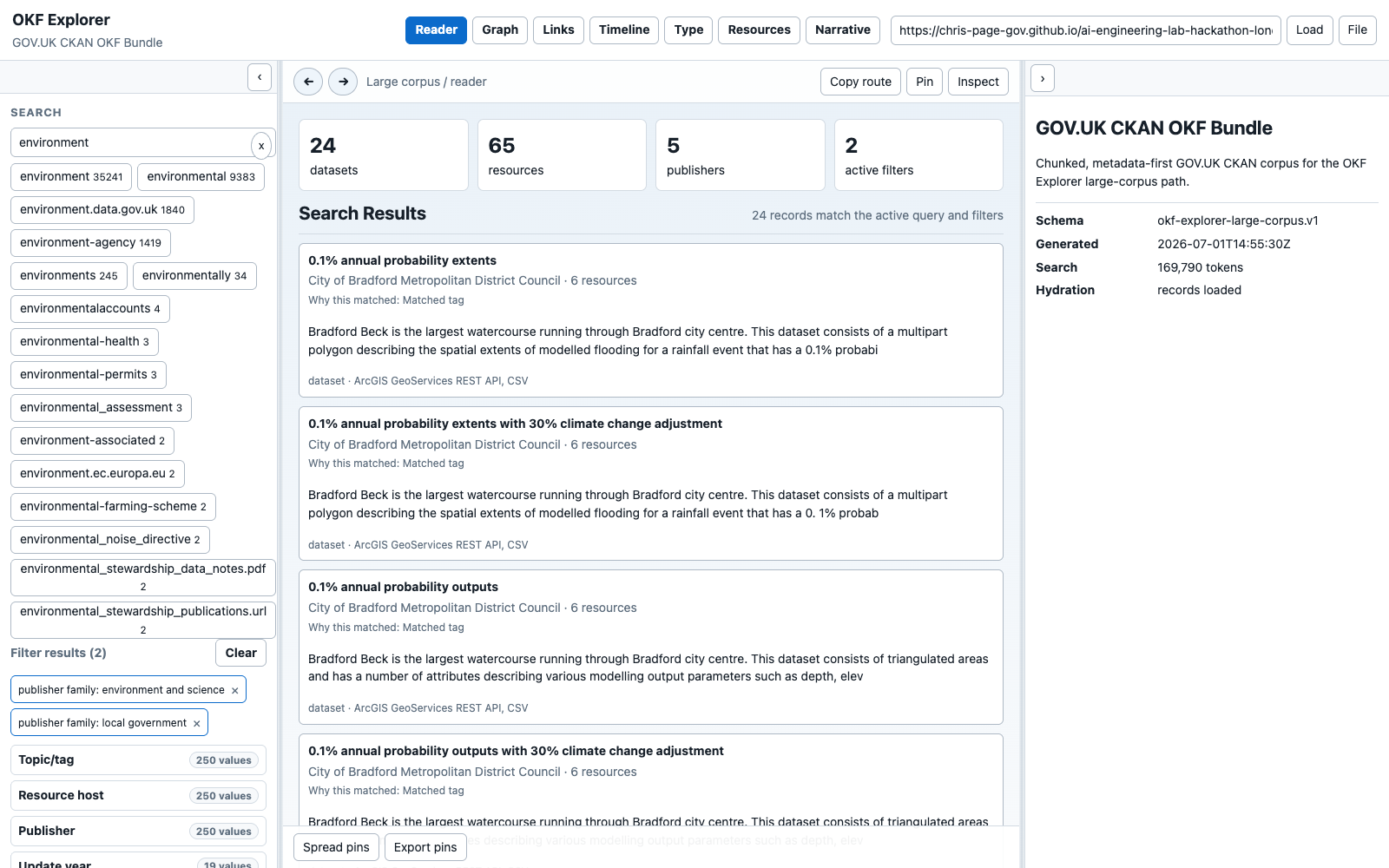
Here the two publisher-family values are alternatives within one facet, so a
record may be in environment and science or local government. The
query still applies as an additional constraint. Explorer reports 24 matching
records, 65 resources and 5 publishers in the reduced context.
Each active choice becomes a chip:
- select the
xon one chip to remove only that value; - select Clear to remove all facet values; or
- use browser Back/Forward to restore an earlier retrieval state.
With an okf-static-search.v2 corpus, filters are applied before the result
limit and facet counts are recalculated using the query plus every active
filter except the facet whose choices are being counted. Missing indexed
values use an internal sentinel but are always displayed as Not specified
(metadata gap).
4. Choose A Sort Order
The Sort menu offers:
| Sort | Behaviour |
|---|---|
| Relevance | Uses the selected deterministic lexical ranking for a text query. With no query it falls back to newest. |
| Newest | Orders by the best available record timestamp, then title. |
| Title | Orders alphabetically by title. |
| Metadata quality | Orders by the recorded metadata-quality signal, then title. This is a completeness signal, not service assurance. |
Defaults are intentional:
- a text query defaults to Relevance;
- filter-only browsing defaults to Title; and
- choosing a different sort writes it to the public URL.
The ranking benchmark evaluates current weighted scoring, field-weighted IDF, and IDF with exact title/identifier/phrase boosts. Weighted scoring remains the default because neither alternative met the required 3% macro nDCG@10 improvement gate without weakening the other safeguards.
5. Share And Restore Retrieval State
Search state is inspectable rather than hidden in application storage. The URL uses this contract:
?q=...&filter.<facet>=...&filter.<facet>=...&sort=...#<route>
The state shown in the third screenshot is equivalent to:
?q=environment
&filter.publisher_family=environment%20and%20science
&filter.publisher_family=local%20government
&sort=metadata-quality
#overview
The two repeated filter.publisher_family parameters preserve the OR
selection. The #overview portion remains the selected Explorer route. On
initial load and browser Back/Forward, Explorer restores the query, valid
filters, sort and selected route. Malformed or unsupported facet keys and sort
names are ignored safely; an unknown value simply cannot match the indexed
corpus. Existing bundle, view and hash links remain compatible.
Small OKF bundles use the same q and sort parameters plus repeated
filter.type values. They do not load the large-corpus worker.
6. Understand V1 And V2 Corpus Behaviour
| Corpus | Search and filter behaviour |
|---|---|
okf-static-search.v2 |
Lazily loads ordinal filter postings, applies filters before limiting results, calculates dynamic facet counts and returns structured match evidence. A producer may opt into the exact bounded query_policy; without it, strict-AND search remains unchanged. |
| Existing v1 manifest | Continues lexical worker search, reuses legacy publisher postings for recognised organisations and uses the existing full-index filtering path when other filter postings are unavailable. URLs and visible semantics remain the same. |
| Small bundle | Uses in-memory lexical matching, type filters and the shared URL/sort contract. |
The screenshots use the published CKAN v1 corpus to prove compatibility with a
real large corpus. The right panel reports records loaded after the v1
fallback hydrates record data. A v2 rebuild avoids that full hydration for
indexed facets.
7. Troubleshooting
| Symptom | Check |
|---|---|
| Hosted interface looks like the previous release | Confirm the feature branch has been merged and the Pages deployment has completed. Until then, use a local branch build. |
| Search is still preparing | Large corpora load only the lexicon and posting shards needed by the query. Wait for the visible preparation/search status to clear. |
| Selecting a facet loads records | The corpus probably has a v1 manifest or lacks postings for that facet, so Explorer is using the correctness fallback. |
| Result count exceeds the cards shown | The static result limit was reached; the total is the candidate count, not the number of rendered cards. |
| A filter disappears from a copied URL | Its facet key is unsupported or malformed and was ignored safely. An unknown but well-formed value instead produces an empty reduction. |
| Metadata quality appears high | Treat it as record completeness only. Inspect provenance, source, confidence, licence and contract fields separately. |
For Graph, Timeline, Type and Resources workflows, continue with the broader OKF Explorer Persona Manual.